Is your council tax band too high?
A free council tax band check: enter your postcode and we read the official records for your property and show you what they say — in about a minute.
- Enter your postcode and choose your address
- We read your band from the Valuation Office Agency register
- You see which records exist on your home before you decide anything
A typical terrace. Every property at a postcode is banded on its April 1991 value, and neighbours’ bands are public record.
How this works
Enter your postcode
Pick your property and we run the free council tax band check. About a minute, no account.
We read six public records
Every fact in your results names where it came from.
VOA band registerLand Registry salesEPC recordsplanning recordsflood datapublished tribunal decisions- VOA band register
- Land Registry sales
- EPC records
- planning records
- flood data
- published tribunal decisions
What your free check shows
- VOA register: 22 properties on this postcodeEvery neighbour’s band, listed
- Land Registry: 26 sales nearbyEach sale deflated to its 1991 value, with the band it implies
- EPC: a certificate is on record for this addressFloor area set against the neighbours’
- Valuation Tribunal: published decisions from the last 6 years, across EnglandAny decision on this home, or on a near-identical home nearby, listed with its date
- Planning and environmental records: 8 on fileListed-building, conservation-area and flood records
The full picture is in the report: the 1991 valuation, the boundary comparisons, and what each record shows, whichever band it points to.
Example: a Band C property in Basingstoke
Sources: VOA band register; Land Registry Price Paid; Valuation Tribunal for England (VTE) published decisions.
What the report adds
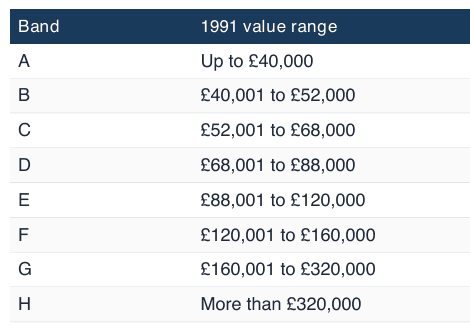
- The 1991 band thresholds and the boundary analysis for this property
- The Land Registry sales near your postcode, each deflated to its 1991 value with the band it implies
- This property’s EPC record set against its neighbours’
- Planning, listed-building, conservation-area and flood records
- Any tribunal decision on this home, or on a near-identical home nearby, listed
- What each record shows, whichever band it points to
- The 25-page Council Tax Band Guide, included with the report
Get the report and guide
Intelligence Report + Guide
£4.99
What public records hold on your property, each with its source, plus the guide.
- The 25-page Council Tax Band Guide
- Your personalised property report
- Sales at 1991 values, set against the band limits
- What each record shows, whichever band it points to
14-day refund if the report contains a material error.
Frequently asked questions
Use our council tax band checker at the top of this page. Enter your postcode, select your property, and we instantly compare your band against every neighbouring property using official VOA data. It takes less than 60 seconds and no sign-up is required.
Your council tax band depends on what your property would have been worth on 1 April 1991 (or 1 April 2003 in Wales). The best way to check is to compare your band against similar neighbouring properties — use our checker above to do this instantly.
Yes. If the Valuation Office Agency agrees your band should be lowered, your council must refund the difference for every year you overpaid at the higher rate. Refunds are backdated to when you moved into the property — there is no time limit.
Every property is assigned a council tax band based on its value on a fixed valuation date — 1 April 1991 in England and Scotland (bands A to H), and 1 April 2003 in Wales (bands A to I). If the Valuation Office Agency (England and Wales) or the Scottish Assessors (Scotland) decides a property was placed in the wrong band, it can be changed — this is called rebanding. If your band goes down, you’re owed the difference for every year you overpaid.
Yes. If a property you previously lived at has been rebanded (or gets rebanded), you’re entitled to a refund for the period you were the council tax payer. There is no time limit on how far back a refund can go.
Not for our initial check. If a potential issue is found and you want to pursue a claim, your old council tax number helps speed things up — but the council can look you up without it.
TaxBandCheck reads public records: the VOA’s council tax band data, Land Registry sale records, EPC records, planning records and published tribunal decisions. It reports what those records show about your property, with the source of each fact. Only the Valuation Office Agency can change a band.
Your Quick Band Check is free. The Council Tax Band Guide is £4.99, and your personalised report on your own property is included. The VOA challenge process itself is free, and the guide shows you how to do it yourself.
The Valuation Office Agency lets you challenge your council tax band directly at no cost. You’ll need to gather evidence yourself and write your own letter. The £4.99 Intelligence Report + Guide saves you the research legwork. Challenge your band directly at gov.uk: https://www.gov.uk/council-tax-appeals
Simple cases where a rebanding has already happened can be resolved in weeks. If a new challenge needs to be submitted to the VOA, it can take 3–6 months.
Yes, this is possible. The VOA can increase your band if they review it and decide the current band is too low. Our reports show you exactly what the evidence says, so you can make an informed decision before challenging.
The VOA resolves tens of thousands of Council Tax challenges each year. In 2023-24 alone, 27% of resolved challenges resulted in a band reduction. Many experts believe further bands may be incorrect.